On February 28, 2026, the United States and Israel launched air strikes on Iran. Iran struck back at Israel, at American bases, and at its Gulf neighbors, including Qatar’s natural gas export facilities. Within days, Iran’s Revolutionary Guard declared the Strait of Hormuz closed.
Before the war, about a hundred ships a day moved through the strait. By late summer, traffic was averaging about five.
The International Energy Agency called it “the largest supply disruption in the history of the global oil market.”
A Very Narrow Place
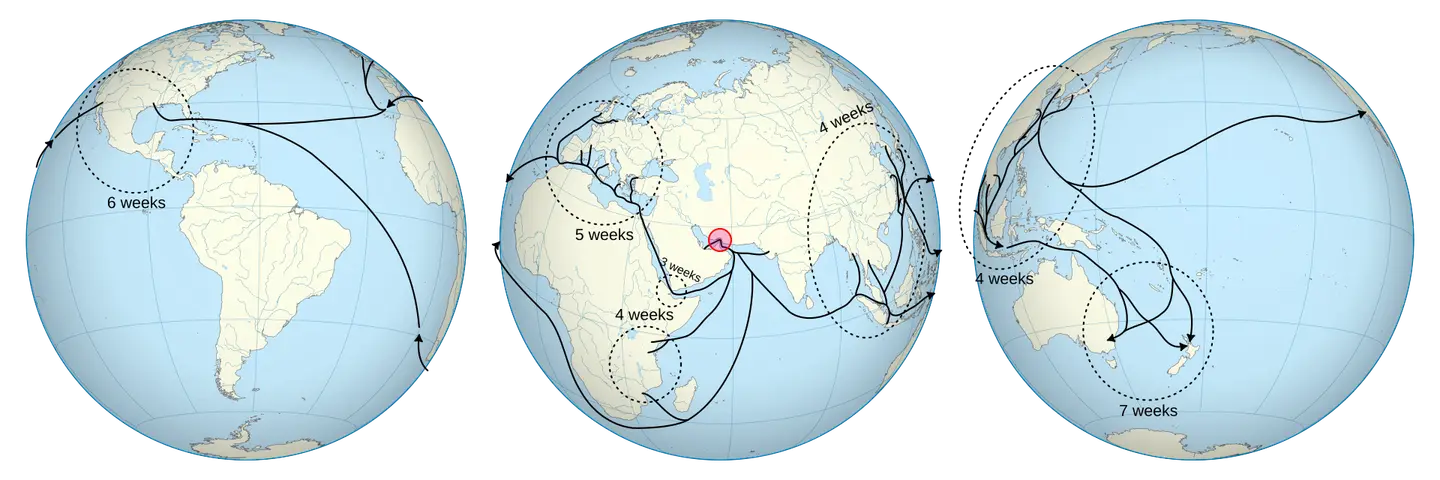
The Strait of Hormuz is the gap between Iran and Oman at the mouth of the Persian Gulf, about 21 miles wide at its narrowest point. Nearly all the oil and gas that Gulf producers ship by sea has to pass through it.
Before the war
A chokepoint is a price shock waiting to happen.
What moved through the Strait of Hormuz in 2024, according to the EIA.
About 20 percent of everything the world consumes.
More than one barrel in four shipped by sea.
Mostly from Qatar.
There are pipelines that can bypass the strait, mostly across Saudi Arabia to the Red Sea, but they can carry only a fraction of normal traffic. When the strait shuts, there’s no detour big enough.

What It Cost You
Brent crude, the global benchmark price for oil, was trading around $72 a barrel the day before the strikes. It closed above $100 on March 12. In mid-April, after peace talks failed, the U.S. Navy began blockading ships going to and from Iranian ports, and at the end of April Brent touched $126.
Governments reached for the emergency tools. IEA member countries agreed to release 400 million barrels from emergency stockpiles, the largest release ever; the U.S. share was 172 million barrels from the Strategic Petroleum Reserve, the federal government’s emergency stash of crude. The White House waived the Jones Act, the law that limits shipping between American ports to American-built, American-crewed vessels, so fuel could move more freely between them. Qatar, the world’s biggest exporter of LNG (natural gas chilled to a liquid so it can travel by tanker), halted production, and European gas prices jumped by a quarter in a single day.
At American gas stations, the average price of regular went from about $2.94 a gallon in late February to $4.50 by May. Diesel, which moves nearly everything you buy, went from about $3.81 to more than $6.50 by late September, the highest national average ever recorded.
A June agreement between Washington and Tehran briefly let more ships through. It unraveled in July, and the U.S. blockade resumed. As of October 1, 2026, the strait still hadn’t reopened (Iran had floated a seven-day reopening plan in late September, which the White House rejected), and regular gasoline was still above $4.40.
The bill arrived everywhere. By August, consumer energy prices were up 16 percent from a year earlier, gasoline 27 percent, airfares 23 percent. In September, with inflation still high, the Federal Reserve raised interest rates.
The Independence Test
In 2025, the year before the war, the United States produced more crude oil than any country in history, about 13.6 million barrels a day. It has been a net exporter of petroleum, selling more abroad than it buys, every year since 2020. Only about 7 percent of its crude imports came through Hormuz, about 2 percent of what it consumes.
By the standard definition of “energy independence,” America was about as independent as an oil consumer can get. And Americans still paid 50 percent more for gasoline and record prices for diesel, because a war closed a strait on the other side of the world.
Drilling didn’t fail. Production was at an all-time high. The problem is how oil works: it’s a global commodity with a global price. When the route for a fifth of the world’s oil closes, every barrel everywhere gets more expensive, including the barrels pumped in West Texas. Your local gas station doesn’t care whether the molecules in your tank ever went near the Persian Gulf. The price system carries the shock to you anyway.
So when a politician says “energy independence” and means “drill more,” the follow-up question writes itself: independence from what? Because in 2026, record domestic production didn’t shield American drivers from a war in Iran, but it did make a lot of domestic producers very profitable during one.
”Isn’t That Asia’s Problem?”
There’s a fair objection here. Most of the oil and gas that moves through Hormuz goes to Asia: about 84 percent of the crude and 83 percent of the LNG in 2024. So you could reasonably say this is really China’s and India’s and Japan’s problem.
This year answered it. A supply shock anywhere moves the price everywhere, and Americans paid it at the pump, at the grocery store, and through the broader inflation that followed. If your household budget depends on a global fuel market staying calm, you’re exposed even when the tanker never points at your port.
Your Outlet Mostly Doesn’t Run On Oil
Petroleum made less than 1 percent of America’s utility-scale electricity in 2025 (that’s the big plants feeding the grid, not rooftops), so no, nobody is claiming tankers power your toaster.
Oil reaches you through everything else. About two-thirds of America’s oil goes to transportation: gasoline, diesel, jet fuel. From there it flows into groceries, shipping, construction, airfares, inflation, and interest rates. Oil isn’t just a fuel. It’s a price system with a passport.
That’s why electrification matters even though the grid barely burns oil. Every car and truck that moves from gasoline or diesel to electricity made at home takes one more piece of daily life out of the reach of the next strait, the next cartel meeting, or the next war. The insulation is partial today, since the grid still burns plenty of natural gas, and gas prices are increasingly tied to world markets too. But every megawatt-hour of wind and solar added to the grid, every unit of electricity those machines actually deliver, comes with no fuel bill at all.
Different Dependencies
Domestic electricity isn’t immune to global supply chains. Panels, turbines, batteries, transformers, copper, and chips all have them, and some are fragile. Pretending otherwise would be dumb.
But there’s a real difference between a machine that needs fuel every day forever and a machine that needs to be built once, maintained, and eventually replaced. A wind turbine doesn’t need OPEC. A solar farm doesn’t call anybody each morning to ask permission to run. If a supplier cuts you off, the panels you already have keep working. If a strait closes, the gas you already burned is gone and you need more tomorrow.
That difference comes with a caveat, and it’s a big one. The IEA found in 2022 that China held more than 80 percent of every major stage of solar-panel manufacturing, from the raw polysilicon to the finished panel, and that its share of the earliest stages would soon reach almost 95 percent. Its later forecasts expect China to keep more than 80 percent through 2030. Call it what it is: a dependency.
So an America-first case for clean power can’t be “buy panels from wherever and stop thinking.” It has to be: build the factories here, build the wires, train the workers, diversify suppliers, and process critical minerals with care where we have to. Don’t trade OPEC for Beijing and call it independence.
Read The Map
China isn’t building renewables to earn a gold star from an environmental group. It still burns staggering amounts of coal and isn’t the hero of this book. That’s exactly why it’s worth watching.
China imports roughly 70 percent of its crude oil, and a large share of that has come through Hormuz. A government that looks at that map doesn’t need a climate conscience to decide that domestic electricity is a security policy. In 2024 China spent more than $625 billion on clean energy, according to the IEA, and it hit its 2030 wind-and-solar target six years early. By the time the strait closed, according to the World Resources Institute, about half the new cars sold in China were plug-in electrics, and about a third of new heavy trucks were electric.
Virtue has nothing to do with it. A country exposed to sea lanes it can’t control decided to need them less.
Americans like independence, strength, and not getting pushed around. So do I. Those instincts earn their keep when they’re aimed at actual control instead of slogans. A serious country shouldn’t wave off cheap domestic electricity as “green” while defending a fuel system whose price can be set by a war in somebody else’s strait.
The Shock Doesn’t Build Anything
It would be nice to say the 2026 crisis converted everybody. It didn’t, and the reason matters.
A price shock can make an electric car feel less like a statement and more like a hedge, and rooftop solar with a battery feel like one less way for a war to reach your house. But a shock doesn’t build anything on its own. The households and countries that had already built the machinery had something to lean on. Everyone else got a slogan.
In the U.S., the war arrived a few months after Congress ended federal EV tax credits, and new electric-car sales in the second quarter of 2026 were down about 20 percent from a year earlier, even with gasoline above $4. That cuts against my side of the argument: American EV demand was still leaning on the credit. War doesn’t automatically produce wisdom. It mostly reveals the machinery that was already in place.

The household-scale lesson: solar, storage, and an EV don't predict the next crisis. They reduce how many crises get a vote in your life.
Video and sources ↗Resilience is a modest question: how much of the next bad week has to reach your budget?
What Independence Should Mean
“Energy independence” shouldn’t mean producing enough fuel to participate confidently in a fragile global market. It should mean shrinking how much of your life has to care what that market is doing. That points toward electrification, efficiency, domestic manufacturing, storage, transmission, and a politics that treats cheap electrons as national strength. Other countries already treat this as strategy. The U.S. keeps treating it like a personality.
And when someone says, “Fine, but what happens when the sun goes down?” that deserves a serious answer. The question is real. It’s just not the gotcha some people think it is.